Loading...

What is Kosmic Kabbalah Art?

The word 'cosmos' refers to the physical universe seen as an orderly harmonious Whole.  The original Greek word 'Kosmos' however, refers to the Whole of all existence - in all realms - physical, emotional, mental and spiritual. The Hebrew word Kabbalah refers to the ancient mystical teachings that describe the Kosmos as an orderly harmonious Whole.

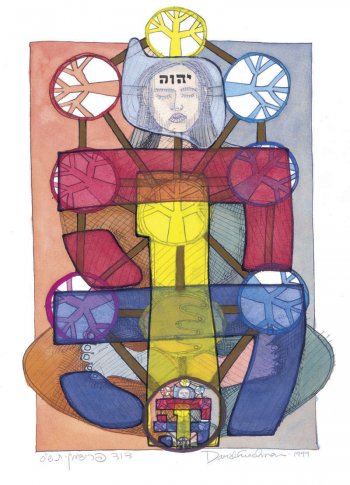
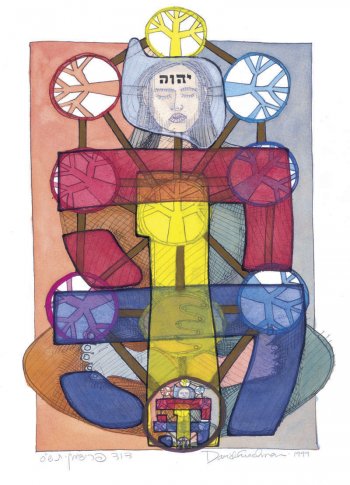
The teachings and much of the artwork presented on this site deal with Kosmic themes that are based on the Kabbalah:  Infinity, Eternity, Kosmogeny, Holy Names, Mandalas,  Sacred Geometry, Fractals, and Sefirotic Maps of the Kosmos (Tree of Life Diagrams).


All of the Giclee prints on canvas as well as all the prints on paper are hand-signed.  The canvas prints can be stretched and framed without glass.  The paper prints should be framed with glass.

There are some new pictures that are only now available as Giclee prints on canvas.  To view them go to 'New Works' under the 'Artworks by Subject' heading.


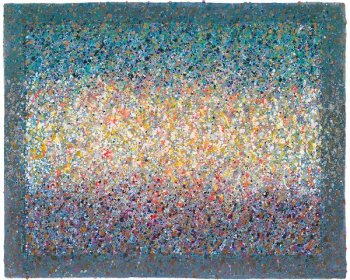
Some people see this picture as stars in space, but I see it as subatomic particles, quanta.  That is why I named it Quantum Uncertainty. According to the Kabbalah, everything created  - whether large or small is relative and subjective.  Only God is Absolute and Unlimited.  Even the totality of Space is 'tiny' compared to the Divine Infinity; and even the particles that… more
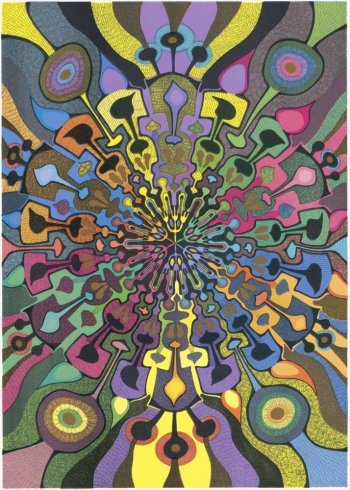
In the Passover song ‘Who Knows One?’, when we answer “God is One in Heaven and Earth” we mean that God is both transcendent (unknowable and so far beyond us) and  immanent (right here within us) at the same time.  Really, these are not two different things.  Transcendent God (in Heaven) and Immanent God (in Earth) is One.  A good word for this is non-dual.  The red ש… more
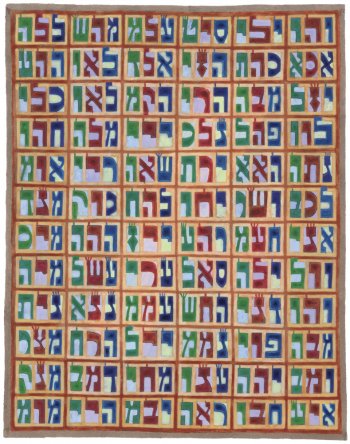
One of the most complex meditative techniques of the Kabbalah uses the 72 three-letter Names of God in this picture.  These 216 letters (72 x 3 = 216) actually comprise One Name. This Name is mentioned in the Bahir and the Zohar, in Rashi’s commentary on the Talmud, but it was Rabbi Abraham Abulafia, the controversial 13th Century Kabbalist, who taught how to use this Name in order to attain… more
The design of this picture is based on the Geometry used in my picture 'The Holy Palace' and derives from the order of the 22 Hebrew Letters according to Sefer Yetzirah - 3 Mothers, 7 Doubles, and 12 Simple Letters. There is a feeling here of spacial relativity I learned from the art of M. C. Escher.  It is hard to know which is the floor, or wall, or roof, of each 'chamber'.  Also,… more
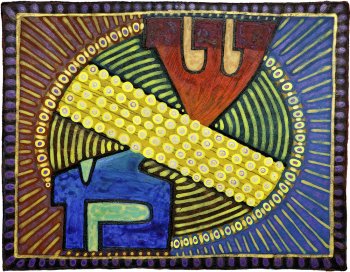
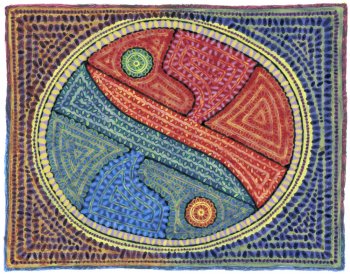
The idea non-duality is found in many spiritual traditions.  In this picture I fused the Hebrew letter א Aleph with the Chinese Yin-Yang symbol.  Both symbols represent non-duality or the unification of opposites:  Heaven and Earth, Hot and Cold, Masculine and Feminine, Outside and Inside, etc. The small circles inside both halves represent how there is Feminine is the Masculine;… more
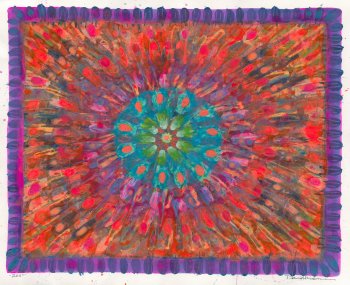
I call this picture Supernova because of its explosion of warm colors away from the cool center.  "Supernovae are exploding stars. They represent the very final stages of evolution for some stars. Supernovae explosions release tremendous amounts of energy, about 1020 times as our Sun releases every second. Our Sun, fortunately, will not end its life as a supernova. Currently,… more
Albert Einstein said “Science without Religion is lame, and Religion without Science is blind.”  The Kabbalists have always seen the two as complementary rather than contradictory.  The cosmology of Kabbalah and of Modern Science can also be seen as complementary perspectives. In the Kabbalah, the Creation of the Universe is spoken of as a contraction of God’s  Infinite Light.… more
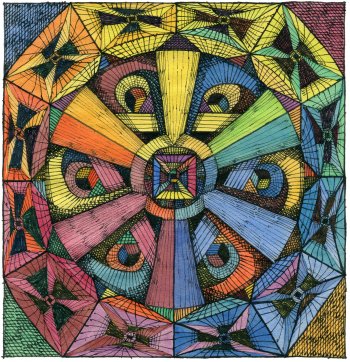
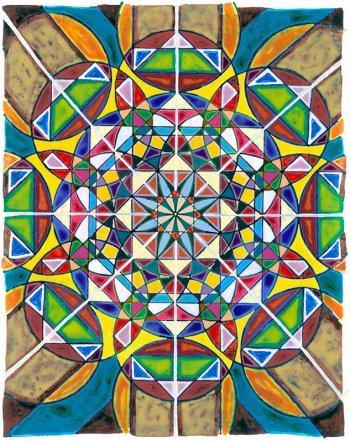
This geometric picture is based on the number 8.  I play with the shape of 8 in several pictures - see the Infinite 8; and the Infinite Aleph.  8 represents the Infinite One that is beyond Space and Time.  The High Priests in the Tabernacle and Temple would wear 8 vestments - 4 white line and 4 elaborately spun with gold thread.  Numbers in Time is Music.  Many… more

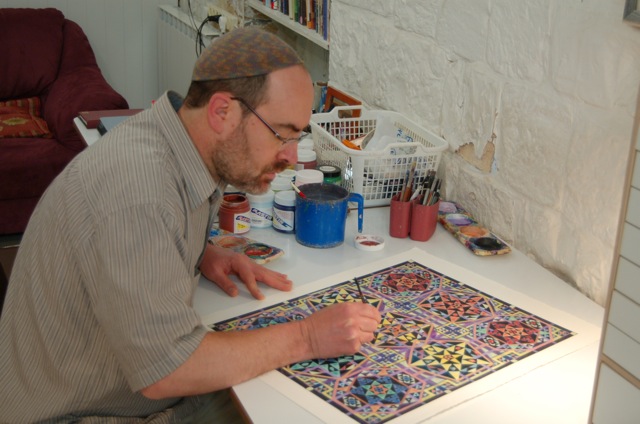
THE ARTIST DAVID FRIEDMAN

I immigrated to Israel in 1977 at the age of 20, and spent two years studying Torah in Jerusalem, where I met my wife, Miriam. We got married in 1979 and moved to Zefat.

In Zefat, I mostly immersed myself in the study of the Talmud and other classic texts of Judaism as well as Kabbalah, but I continued to make art at night. 
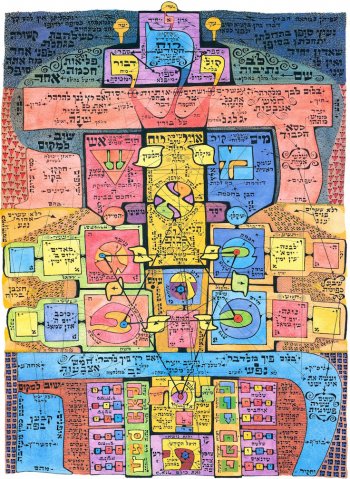
READ DAVID'S STORY

latest teachings

Sefer Yetzirah Motherboard
Sefer Yetzirah
|

Since the ancient classic Sefer Yetzirah (Book of Creation) inspires much of the art that is shown on this site, I feel that is

Read More
Meditating on the Holy Name
The Third Temple
|

In the Torah, God commanded the Children of Israel to build a tabernacle, a Mishkan, a dwelling place for His Presence, the Shechinah.  God

Read More

FIND US
Call Us

+972 54 2027832

Address

38 Bar-Yochai Street, Safed, Israel  

Open the map
Close the map