Loading...

What is Kosmic Kabbalah Art?

The word 'cosmos' refers to the physical universe seen as an orderly harmonious Whole.  The original Greek word 'Kosmos' however, refers to the Whole of all existence - in all realms - physical, emotional, mental and spiritual. The Hebrew word Kabbalah refers to the ancient mystical teachings that describe the Kosmos as an orderly harmonious Whole.

The teachings and much of the artwork presented on this site deal with Kosmic themes that are based on the Kabbalah:  Infinity, Eternity, Kosmogeny, Holy Names, Mandalas,  Sacred Geometry, Fractals, and Sefirotic Maps of the Kosmos (Tree of Life Diagrams).


All of the Giclee prints on canvas as well as all the prints on paper are hand-signed.  The canvas prints can be stretched and framed without glass.  The paper prints should be framed with glass.

There are some new pictures that are only now available as Giclee prints on canvas.  To view them go to 'New Works' under the 'Artworks by Subject' heading.


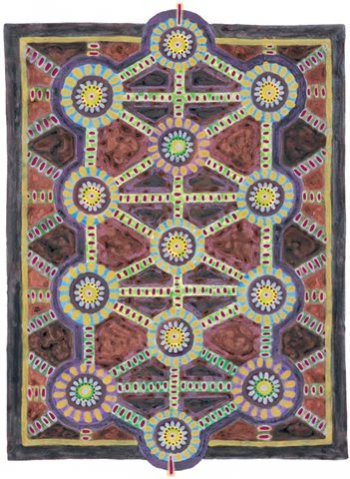
"10 Sefirot of Nothingness: Their end is embedded in their beginning and their beginning is embedded in their end like a flame tied to a burning coal For the Master is Singular, He has no second and before One what do you count?" (Sefer Yetzirah)   A common meditative technique in the Kabbalah is to contemplate the flame of a burning lamp.  Our soul is likened to the energy of the… more
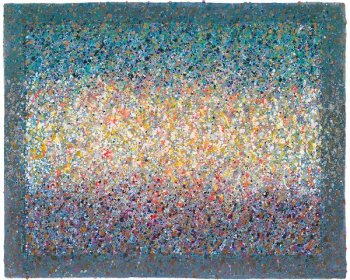
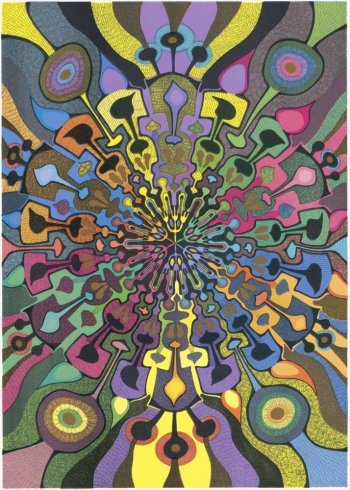
This pictures looks like something one might see under a microscope, thus the title - Microkosmic.  To me it looks like cells that have a fractal nature - self-similar but in different sizes.  Some of the cells also contain several smaller self-similar cells.  The round shapes also evoke a coronavirus, that is challenging our planet in 2020.
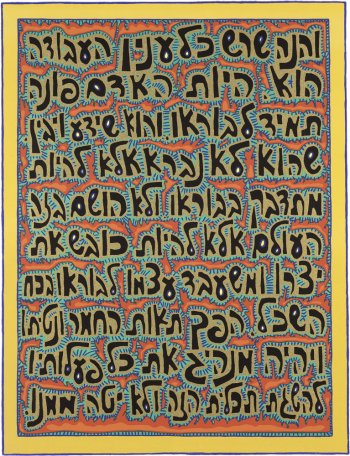
In the Passover song ‘Who Knows One?’, when we answer “God is One in Heaven and Earth” we mean that God is both transcendent (unknowable and so far beyond us) and  immanent (right here within us) at the same time.  Really, these are not two different things.  Transcendent God (in Heaven) and Immanent God (in Earth) is One.  A good word for this is non-dual.  The red ש… more
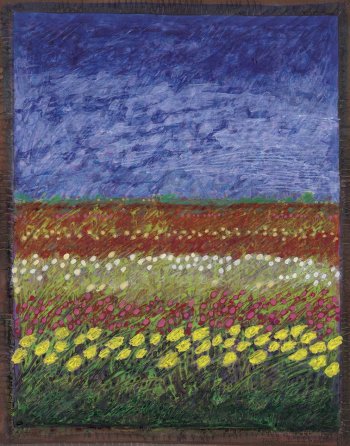
This is an imaginary landscape I made with many layers of watered-down acrylic paint.  It has the feeling of a pastoral scene here in the Galilee, and the choice of colors was definitely influenced by the local landscape.  There are no hidden symbols and nothing Kabbalistic here. 
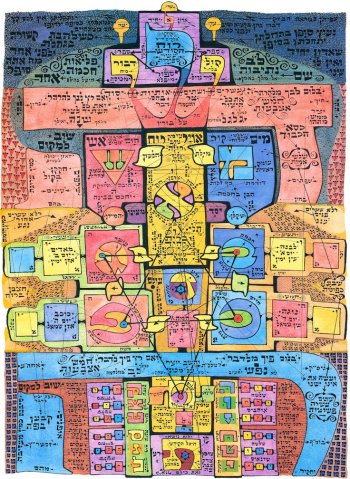
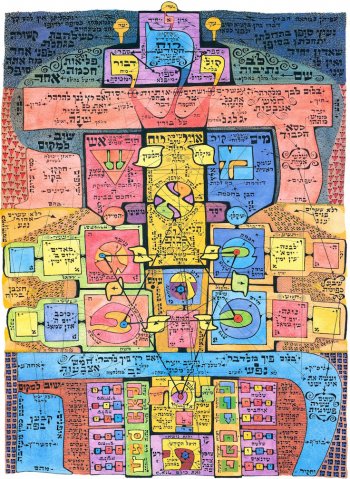
Most of the concepts that are presented in Sefer Yetzirah appear in this image.  The 22 Hebrew Letters and 10 Numbers (Sefirot) are said to be the building blocks of Creation, It is not so different from the letters and numbers that represent the building blocks of matter in the Periodic Table of the Elements, and the subatomic particle Zoo.  Because this picture looks like the… more
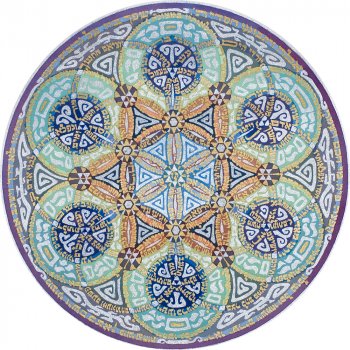
One of the most complex meditative techniques of the Kabbalah uses the 72 three-letter Names of God in this picture.  These 216 letters (72 x 3 = 216) actually comprise One Name. This Name is mentioned in the Bahir and the Zohar, in Rashi’s commentary on the Talmud, but it was Rabbi Abraham Abulafia, the controversial 13th Century Kabbalist, who taught how to use this Name in order to attain… more
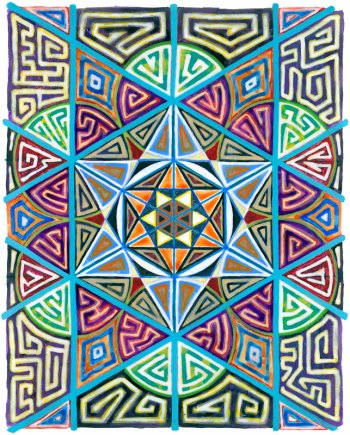
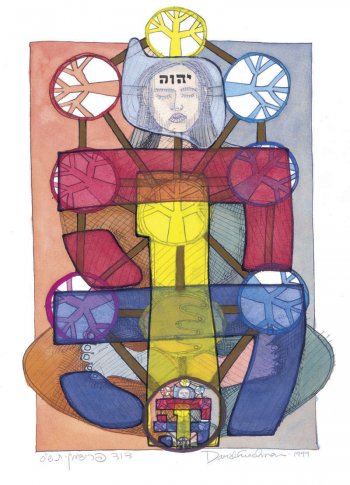
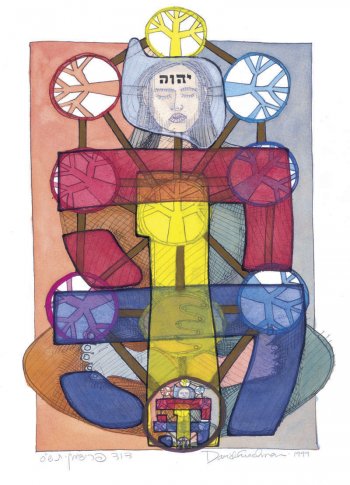
In Sefer Yetzirah the 10 Sefirot are always referred to as Sefirot of Nothingness בלימה (blimah).  Unlike the 22 Letters which can be expressed in speech, the10 Sefirot are conceptual, perceived in the mind.  And so are numbers. This image depicts the 10 Sefirot  as a Tree of Life Diagram with 3 vertical columns.  It representsthe human form as a reflection of the Divine.… more
I used flowers to represent the Sefirot in this Tree of Life Diagram.  Although an Aleph cannot be seen in this picture, its presence can be felt in this ‘Slanted Sefirot’ motif where the red higher Sefirot hint at the Heavens; the blue lower Sefirot hint at Earth; and the yellow diagonal hints at the Air that is between them.

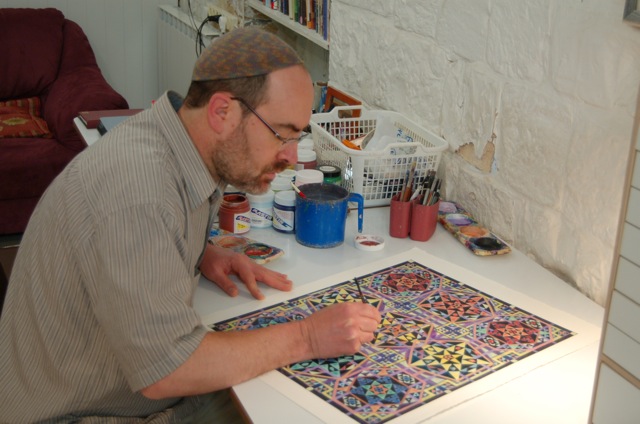
THE ARTIST DAVID FRIEDMAN

I immigrated to Israel in 1977 at the age of 20, and spent two years studying Torah in Jerusalem, where I met my wife, Miriam. We got married in 1979 and moved to Zefat.

In Zefat, I mostly immersed myself in the study of the Talmud and other classic texts of Judaism as well as Kabbalah, but I continued to make art at night. 
READ DAVID'S STORY

latest teachings

Sefer Yetzirah Motherboard
Sefer Yetzirah
|

Since the ancient classic Sefer Yetzirah (Book of Creation) inspires much of the art that is shown on this site, I feel that is

Read More
Meditating on the Holy Name
The Third Temple
|

In the Torah, God commanded the Children of Israel to build a tabernacle, a Mishkan, a dwelling place for His Presence, the Shechinah.  God

Read More

FIND US
Call Us

+972 54 2027832

Address

38 Bar-Yochai Street, Safed, Israel  

Open the map
Close the map